
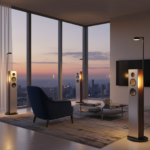
Demystifying Speaker Placement: Unlocking Your Home Audio’s Full Potential
Ever wondered why your expensive new speakers don’t sound as good at home as they did in the store? The secret might not be the speakers themselves, but where you’ve placed them. Speaker placement is often overlooked, yet it’s one of the most critical factors influencing sound quality in any home audio setup. This article will guide you through the fundamental principles of speaker positioning, helping you transform your listening experience from ordinary to extraordinary, without needing to upgrade a single piece of equipment.
The Golden Triangle: Your Sonic Sweet Spot
The “golden triangle” is the cornerstone of optimal stereo speaker placement. Imagine an equilateral triangle: your listening position (your head) forms one point, and your two main stereo speakers form the other two points. Each side of this triangle should ideally be equal in length. This setup ensures that the sound from both speakers arrives at your ears simultaneously and with equal intensity, creating a focused and immersive stereo image. While a perfect equilateral triangle is the ideal, slight variations can work depending on your room’s dimensions. Experiment with moving your listening position forward or backward a few inches until the soundstage feels cohesive and centered.
Beyond the Triangle: Walls, Corners, and Toeing In
Once you’ve established your golden triangle, it’s time to consider the room itself. Walls, especially those directly behind the speakers, can significantly impact bass response. Placing speakers too close to a wall often exaggerates bass, making it boomy and uncontrolled. As a general rule, try to keep bookshelf speakers at least 6-12 inches away from the back wall, and floorstanders even further, perhaps 1-3 feet. Corners are even worse offenders, notoriously boosting bass to an undesirable degree. Avoid placing speakers directly into corners unless your room acoustics demand it. “Toeing in” refers to angling your speakers slightly inwards towards your listening position. This can enhance the stereo imaging and focus the soundstage. Start with the speakers facing straight ahead, then gradually toe them in a few degrees at a time, listening for improvements in clarity and instrument separation. Be careful not to over-toe, as this can make the sound too narrow and lose its spaciousness.
Common Mistakes to Avoid: From Clutter to Unevenness
One of the most common mistakes is placing speakers on cluttered surfaces or among objects that can reflect or absorb sound. Ensure the area immediately surrounding your speakers is as clear as possible. Bookshelves, plants, and large pieces of furniture can all interfere with sound wave propagation. Another frequent oversight is placing speakers at uneven heights or using unstable stands. Speaker tweeters (the small drivers responsible for high frequencies) should ideally be at ear height when you’re in your primary listening position. Wobbly stands can introduce unwanted vibrations that degrade sound quality; invest in sturdy, well-damped stands for bookshelf speakers. Finally, remember that every room is unique. While these guidelines provide a fantastic starting point, the absolute best placement for your speakers will involve a bit of trial and error. Don’t be afraid to experiment! Spend an afternoon moving your speakers, even by small increments, and actively listening to the changes. You’ll be surprised at the difference a few inches can make. By understanding and applying these simple principles, you’ll unlock a richer, more detailed, and utterly captivating listening experience, transforming your home audio from good to truly great.
